QCustomSlideMenu
QWidget(self, /, parent: PySide6.QtWidgets.QWidget | None = None, f: PySide6.QtCore.Qt.WindowType = Default(Qt.WindowFlags), *, modal: bool | None = None, windowModality: PySide6.QtCore.Qt.WindowModality | None = None, enabled: bool | None = None, geometry: PySide6.QtCore.QRect | None = None, frameGeometry: PySide6.QtCore.QRect | None = None, normalGeometry: PySide6.QtCore.QRect | None = None, x: int | None = None, y: int | None = None, pos: PySide6.QtCore.QPoint | None = None, frameSize: PySide6.QtCore.QSize | None = None, size: PySide6.QtCore.QSize | None = None, width: int | None = None, height: int | None = None, rect: PySide6.QtCore.QRect | None = None, childrenRect: PySide6.QtCore.QRect | None = None, childrenRegion: PySide6.QtGui.QRegion | None = None, sizePolicy: PySide6.QtWidgets.QSizePolicy | None = None, minimumSize: PySide6.QtCore.QSize | None = None, maximumSize: PySide6.QtCore.QSize | None = None, minimumWidth: int | None = None, minimumHeight: int | None = None, maximumWidth: int | None = None, maximumHeight: int | None = None, sizeIncrement: PySide6.QtCore.QSize | None = None, baseSize: PySide6.QtCore.QSize | None = None, palette: PySide6.QtGui.QPalette | None = None, font: PySide6.QtGui.QFont | None = None, cursor: PySide6.QtGui.QCursor | None = None, mouseTracking: bool | None = None, tabletTracking: bool | None = None, isActiveWindow: bool | None = None, focusPolicy: PySide6.QtCore.Qt.FocusPolicy | None = None, focus: bool | None = None, contextMenuPolicy: PySide6.QtCore.Qt.ContextMenuPolicy | None = None, updatesEnabled: bool | None = None, visible: bool | None = None, minimized: bool | None = None, maximized: bool | None = None, fullScreen: bool | None = None, sizeHint: PySide6.QtCore.QSize | None = None, minimumSizeHint: PySide6.QtCore.QSize | None = None, acceptDrops: bool | None = None, windowTitle: str | None = None, windowIcon: PySide6.QtGui.QIcon | None = None, windowIconText: str | None = None, windowOpacity: float | None = None, windowModified: bool | None = None, toolTip: str | None = None, toolTipDuration: int | None = None, statusTip: str | None = None, whatsThis: str | None = None, accessibleName: str | None = None, accessibleDescription: str | None = None, accessibleIdentifier: str | None = None, layoutDirection: PySide6.QtCore.Qt.LayoutDirection | None = None, autoFillBackground: bool | None = None, styleSheet: str | None = None, locale: PySide6.QtCore.QLocale | None = None, windowFilePath: str | None = None, inputMethodHints: PySide6.QtCore.Qt.InputMethodHint | None = None) -> None
At a glance
| Tier | Free (GPLv3) |
| Import | from Custom_Widgets.QCustomSlideMenu import QCustomSlideMenu |
| Qt Designer | Yes — drag it from the palette |
Quick start
from Custom_Widgets.QCustomSlideMenu import QCustomSlideMenu

widget = QCustomSlideMenu()
lay = _intoLayout(w)
title = QLabel("Workspace")
title.setStyleSheet("font-size: 14px; font-weight: 600;")
lay.addWidget(title)
for text in ("Dashboard", "Projects", "Messages", "Settings"):
lay.addWidget(QPushButton(text))
lay.addStretch(1)
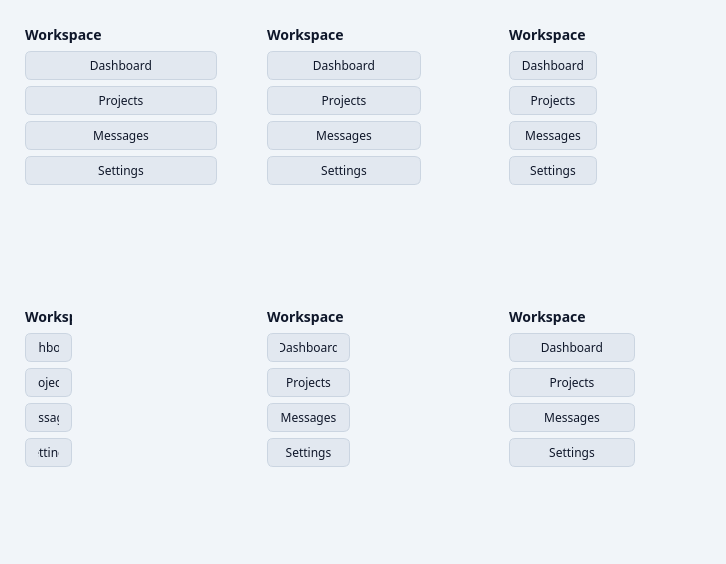
widget.customizeQCustomSlideMenu(defaultWidth=210, defaultHeight=250,
                        collapsedWidth=64, collapsedHeight=250,
                        expandedWidth=210, expandedHeight=250)
widget.sizeHint = lambda: QSize(210, 250)
That is the exact code behind the screenshot above.
Dark theme
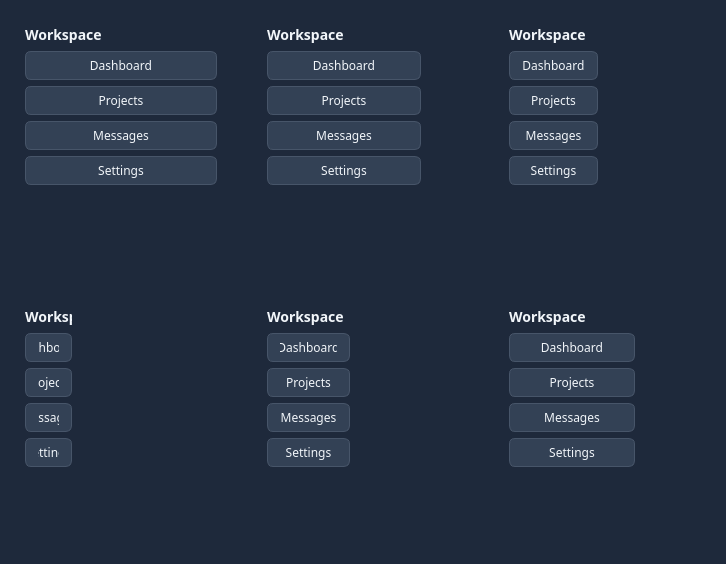
Colours come from the design tokens, so the widget follows the app theme with no extra work.
Signals
| Signal |
|---|
onCollapsed() |
onCollapsing() |
onExpanded() |
onExpanding() |
Methods
| Method | Description |
|---|---|
activateMenuButton(buttonObject) | Activate menu button. |
adjustMaximumSize(property_name) | Adjust maximum size. |
animateDefaultSize() | Determines if the widget is in an expanded state by comparing its |
animateMenu() | Animate menu. |
autoContentSize() | Size used for the legacy "auto" width/height value: the widget's |
calculateEndHeight(height) | Calculate end height. |
calculateEndWidth(width) | Calculate end width. |
collapseMenu() | Collapse the menu. |
createAnimation(property_name, start_value, end_value) | Create an animation. |
customizeQCustomSlideMenu(**customValues) | Customize Q custom slide menu. |
determineHeight() | Determine height. |
determineWith() | Determine with. |
emitStatusSignal() | Emit status signal. |
eventFilter(obj, event: PySide6.QtCore.QEvent) | Event filter. |
expandMenu() | Expand the menu. |
getButtonByName(buttonName) | Recursively search for a button by objectName in children and parent containers. |
getCollapsedHeight() | Return the collapsed height. |
getCollapsedWidth() | Return the collapsed width. |
getDefaultHeight() | Return the default height. |
getDefaultWidth() | Return the default width. |
getExpandedHeight() | Return the expanded height. |
getExpandedWidth() | Return the expanded width. |
initializeVariables() | Initialize variables. |
isCollapsed() | Determines if the widget is in a collapsed state by comparing its |
isExpanded() | Determines if the widget is in an expanded state by comparing its |
onCollapsed(...) | Handle collapsed. |
onCollapsing(...) | Handle collapsing. |
onExpanded(...) | Handle expanded. |
onExpanding(...) | Handle expanding. |
refresh() | Refresh. |
setMinSize() | Set the min size. |
slideMenu() | Slide menu. |
toggle() | Toggle. |
toggleButton(**values) | Toggle the button. |
toggleMenu() | Toggle the menu. |
Runnable example
A complete app using this widget lives at examples/PySide6/QCustomSlideMenu/main.py.
Related
QCustomBreadcrumbs · QCustomCommandPalette · QCustomDrawer · QCustomHamburgerMenu · QCustomHeaderNav · QCustomMenu · QCustomPagination · QCustomSidebar